Explainers
Size vs geometry: why a bigger suppressor does not mean quieter
The myth "larger volume = quieter" does not hold on a real barrel. How ARCANE intercepts the peak at the inlet, routes the flow through the primary labyrinth and ZERO, and why dimensions are not everything.
Contents
- What makes ARCANE different
- Stage 1. Intercepting the peak impulse at the inlet
- Stage 2. Reversal, cooling, deceleration
- Stage 3. ZERO: equalization and removal of residual impulse
- Stage 4. Controlled exit
- Comparison of approaches
- Why "making it bigger" does not give proportional gains
- FAQ
- More tests and live-fire footage
The most common myth about suppressors: "the larger the volume, the quieter". In a vacuum, that is partially true. On a real barrel, something else decides: where the peak impulse is intercepted, how the flow is directed, how heat is dissipated, and how controlled the gas exit is.
Lower backpressureThe pressure peak does not linger in the housing. The cycling remains closer to factory spec.
Softer impulse frontIt is not only about loudness - the shape of the front matters. An impulse stretched in time is perceived differently.
Heat exchange across the entire systemThe flow passes through the primary labyrinth, and the 7075-T6 housing acts as a radiator over its full surface area.
Controlled exitThe muzzle end is designed so there is no sharp pressure flare at the muzzle face.
What makes ARCANE different
Classic logic - retain gas longer through volume and chambers. Side effects: overheating, rising backpressure, over-gassing into the shooter's face, instability on rapid fire. ARCANE is built differently: gas is not held by force. It is guided through stages with a managed impulse.
Stage 1. Intercepting the peak impulse at the inlet
On a shot the main problem is not "gas volume" but the peak impulse: a short, sharp pressure front with high temperature and velocity.
In ARCANE the flow immediately enters the primary labyrinth, which fragments it and changes its direction. The straight path becomes less preferred compared to the managed lateral route. Impact energy is removed right at the inlet.

Stage 2. Reversal, cooling, deceleration
The gas then travels through a multi-channel architecture with successive reversals. Each reversal bleeds velocity and converts part of the energy into heat. The impulse becomes less aggressive.
A separate factor is heat exchange. The main flow passes through titanium internal components in the hot zone. Heat transfers to the 7075-T6 aluminum housing, which dissipates it passively over its large surface area.
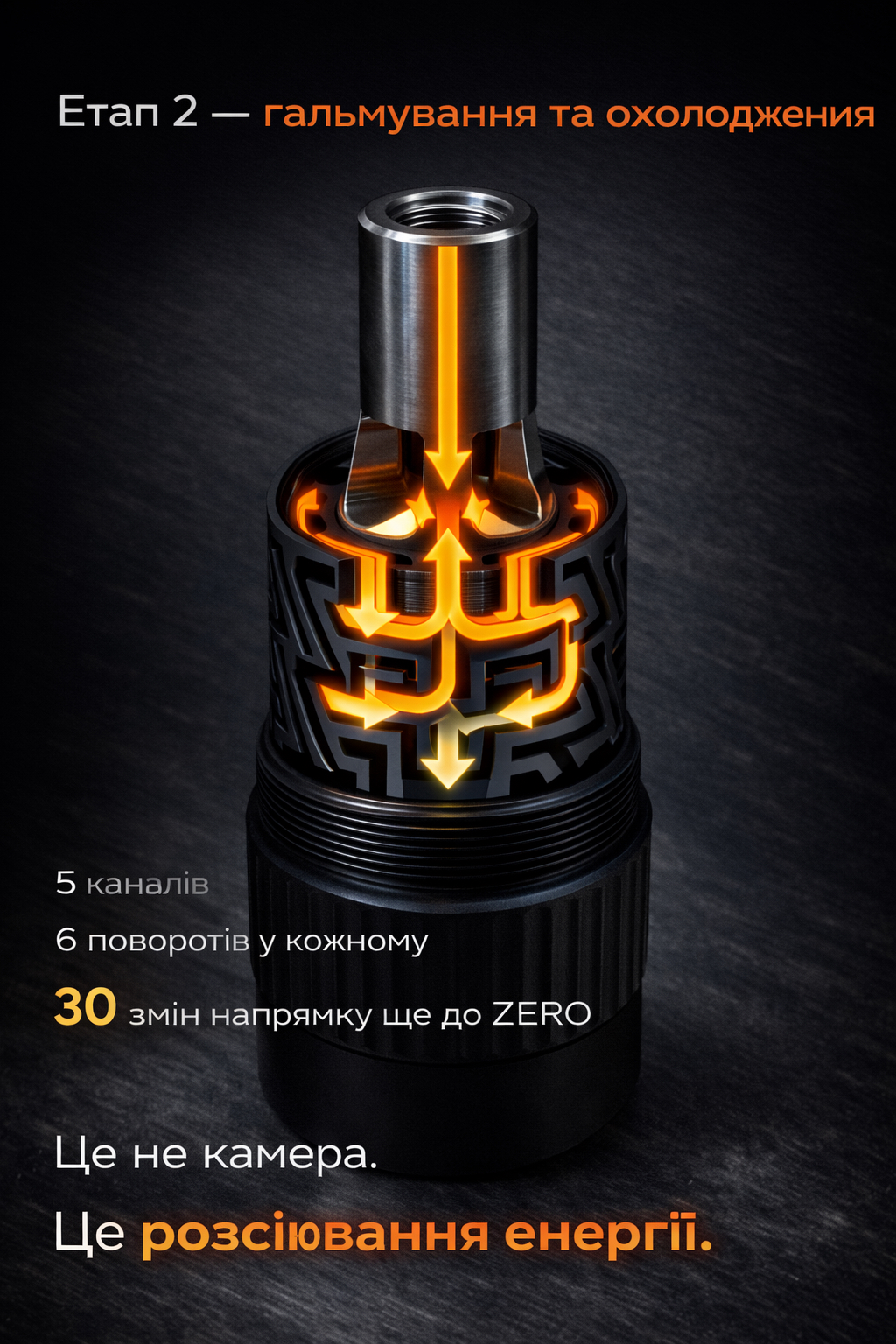
Stage 3. ZERO: equalization and removal of residual impulse
Once the flow is already cooled and decelerated, ZERO engages. Its task is not to "hold by force". Its task is to bring the flow to a controlled state: final deceleration, stabilization, removal of residual impulse.
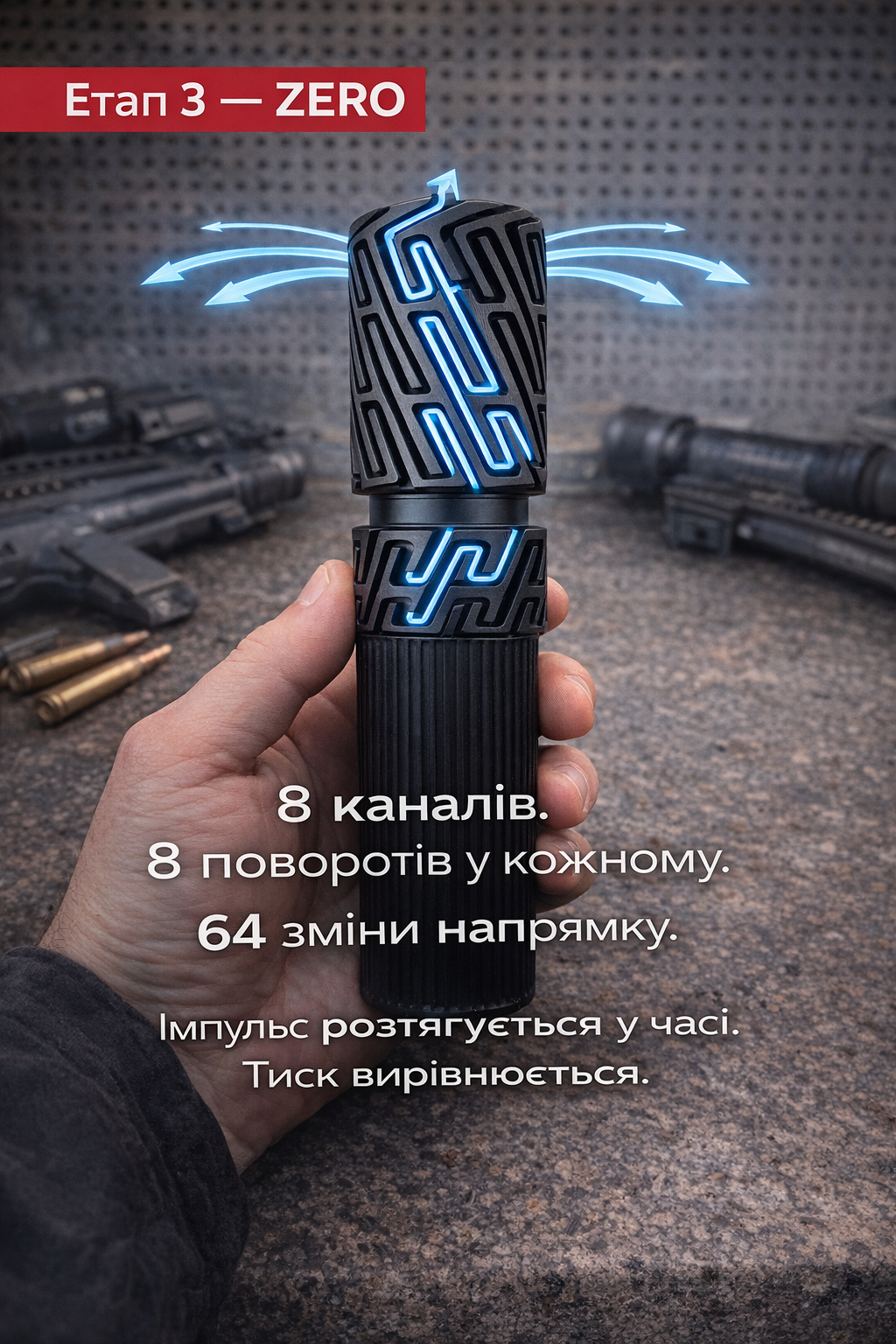
Stage 4. Controlled exit
The final stage is simple: do not create a sharp pressure flare at the muzzle face. When gas exits slower and more evenly, the character of the sound becomes muffled, without a metallic ring, and the exit jet softens.
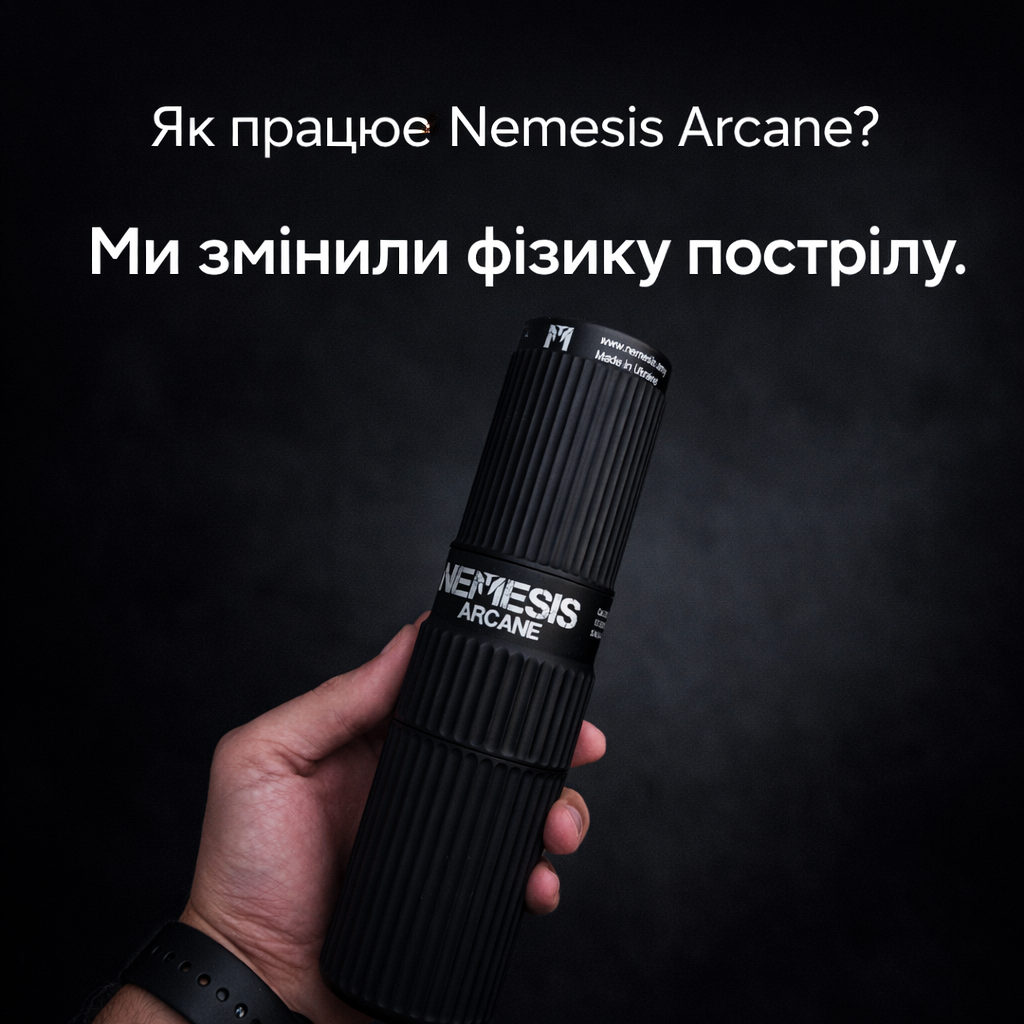
Note: this is a description of the principle. Specific behavior depends on the platform, ammunition, barrel length, and rate of fire.
Comparison of approaches
Classic approachRelies on volume and gas retention. Result - higher backpressure, overheating, gas into the shooter's zone, especially on semi-auto.
ARCANE approachIntercepts the peak at the inlet, routes the flow through the primary labyrinth, dissipates heat across the entire system, equalizes the flow with ZERO before exit.
Why "making it bigger" does not give proportional gains
Yes, greater volume can reduce peak pressure. But the relationship is non-linear: beyond a certain threshold, dimensions and mass grow quickly while additional efficiency grows slowly. ARCANE is designed as an optimum of size / gas dynamics, not a "maximum-size can".
Conclusion: silence is not "size for size's sake". Silence is peak control, a managed trajectory, heat exchange, controlled exit.
Go to catalog ->
Go to catalog ->
FAQ
- Can a larger version be made to order? Yes. But if the only goal is to "add volume", the efficiency gain will be disproportionate to the increase in size and mass.
- Why don't you give a single "magic number"? Because the outcome depends on a complex of factors: the nature of the impulse, over-gassing, thermal behavior, cycle stability - not a single metric.
- Why is the difference more noticeable on semi-auto? Because that is where excess backpressure and gas into the shooter's zone manifest most strongly.
More tests and live-fire footage
Telegram - tests and live fireFull videos, live audio, technical breakdowns, Q&A.
Go to Telegram ->
Go to Telegram ->
Instagram - photos and short reviewsVisual breakdowns, new releases, behind-the-scenes production.
Go to Instagram ->
Go to Instagram ->